Short Wavelength Time Dependence
SWP MXHI Time Dependence
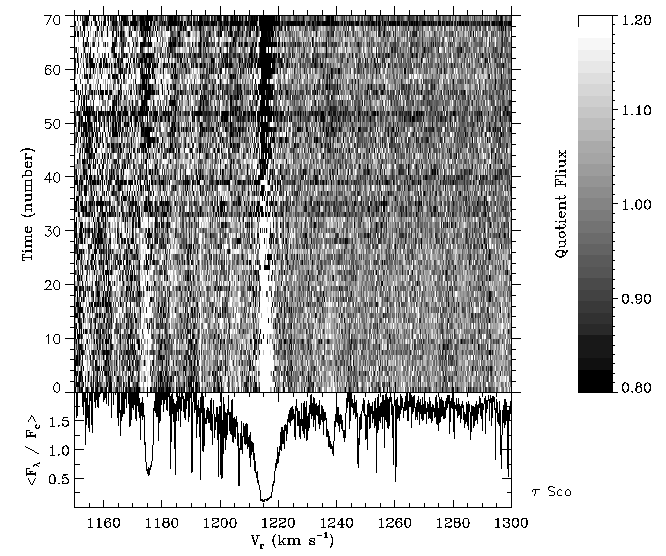
This figure shows the time dependence of SWP NEWSIPS large aperture high
dispersion extractions. It shows the short wavelength region of all the
available well exposed high dispersion spectra (71 in all) of the B0 V
star tau Sco obtained over the lifetime of IUE. The spectra
are normalized by their mean spectrum. The temporal ordinate is simply
the accumulated number of spectra, and is not linear in time. No
smoothing has been done, so individual spectra can be distinguished in the
temporal direction.
Notice the following:
- The regions of the strong lines (e.g., the C+2 1175 Å
multiplet, the interstellar Ly alpha line, and the N +4
1238-42 Å resonance doublet) all grow stronger over the lifetime of the
mission.
- The regular structure which appears throughout the image. This
corresponds to the echelle ripple pattern, with the low flux portion of
the pattern becoming darker over the life time of the mission.
- The flux in the core of the saturated interstellar Ly alpha line
is not zero in the mean spectrum.
- At the shortest wavelengths, the extracted fluxes change by more than
40% at low flux levels over the lifetime of the mission.
Together, the first two points suggest a time dependent systematic effect
which depends upon the flux level of the unextracted spectrum, with low
flux levels being strongly affected and higher flux levels less so. The
third point indicates that this trend results from low flux levels being
overestimated toward the beginning of the mission.
The time dependent effects are strongest in this region. They are weakest
at intermediate (1300-1600 Å)
wavelengths and somewhat weaker at the
longest (1700-1950 Å) wavelengths.