The following are examples of my research activities in cross-dispersion imaging:
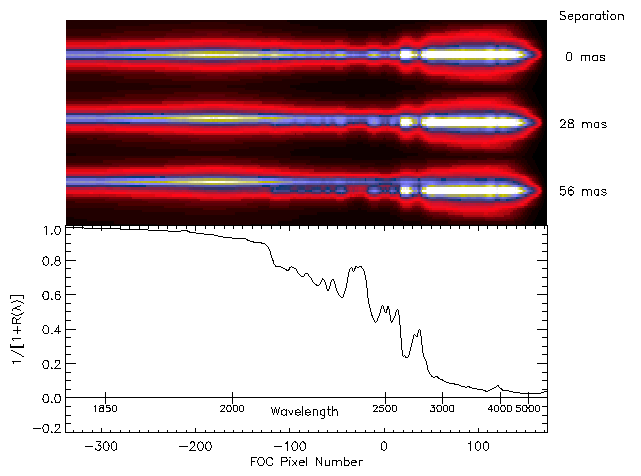
Figure 1 (Top): Simulations of how the dispersed images of the binary Cepheid + A star system AW Per are expected to appear on the FOC detector when the separations of the components of the system perpendicular to the dispersion are: 0 milli arc sec (mas), 28 mas, and 56 mas (a wavelength scale is shown at the bottom). The two spectra lie on top of one another in the uppermost image, are under resolved in the middle one and are just resolved in the lower one. In the resolved image, it is clear that the Cepheid is dominating the long wavelength portion of the spectrum and the A star dominates the short wavelength portion.
(Bottom): The wavelength dependence of the cross-dispersion centroid position derived from the simulated images and normalized to unity. This quantity shows how the centroid shifts from the position of one star to the other and also demonstrates how the presence of strong features in one star, such as the Mg II 2800 Å doublet in the Cepheid, causes the centroid to swing toward the position of the other star over a localized region.
 Cross-dispersion imaging
 Massa and Endal developed the
notion of cross-dispersion imaging to obtain "super-Rayleigh" spatial
resolution for certain applications. I am currently the PI on a Cycle
6 HST GO proposal to apply this technique to binary Cepheid + B
star binaries. If sucessful, it would be the first time that a binary
system with a Cepheid component has been spatially resolved, and would
open up the possibility of bypassing 2 rungs of the "Cosmic Distance
Ladder". A talk decussing the results of these observations delivered
in March 2001 can be found
here.
A further application of this
concept has been proposed for a balloon project entitled
ELFS -- Extremely Long Focal Length
Spectrograph.
Massa and Endal developed the
notion of cross-dispersion imaging to obtain "super-Rayleigh" spatial
resolution for certain applications. I am currently the PI on a Cycle
6 HST GO proposal to apply this technique to binary Cepheid + B
star binaries. If sucessful, it would be the first time that a binary
system with a Cepheid component has been spatially resolved, and would
open up the possibility of bypassing 2 rungs of the "Cosmic Distance
Ladder". A talk decussing the results of these observations delivered
in March 2001 can be found
here.
A further application of this
concept has been proposed for a balloon project entitled
ELFS -- Extremely Long Focal Length
Spectrograph.
Derck Massa,