The following are examples of my research activities in the astronomy and astrophysics of OB star winds:
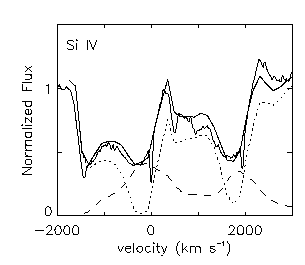
Figure 1(at left): Model fit to the Si IV 1400 Å doublet in the B0.5 Ib supergiant HD 64760. The figure shows the two contributions to the fit: the transmitted (dotted) and scattered (dashed) components (from Massa, Prinja, & Fullerton 1995).
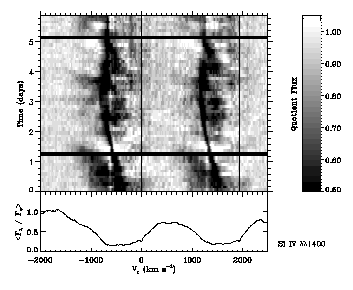
Figure 2(at right): A dynamic spectrum (the abscissa is velocity relative to the blue component of the Si IV 1400 Å doublet and time increases upward) of a 6 day time series of the rapidly rotating B1 Ib star, gamma Ara. The Spectra are normalized by a minimum absorption (maximum flux) template, so that all variations appear as absorptions. Notice that while wind activity extends to roughly -1500 km/s, there is also a distinct feature moving slowly out to a terminal velocity of less than -800 km/s. This indicates the presence of a two component, equatorially compressed, wind (Massa, Prinja, & Fullerton 1996).
A study of FUSE observations of the winds of early LMC O stars. A particularly interesting result from this work is a demonstration that the O VI wind doublet is almost certainly a result of X-ray auger ionization, as first predicted by Cassinelli & Olsen (1979).
A demonstration of variable ionization in the B supergiant HD 150168, and other B supergiants.
I have been interested in the physics of OB star winds for a number of years. Most recently, I have been collaborating with Prinja and Fullerton on several studies of wind variability in B supergiant winds. Some of my work in this field includes:
 Global wind properties
 The discovery of the peculiar
winds in NGC 6231 main sequence B stars (Massa et al. 1984). The
origin of these abnormally strong winds of remains a mystery.
Determination of the relative
abundances of luminous B stars through the analysis of their wind
lines (Massa et al. 1992). This was one of the first quantitative
derivations of CNO abundances from wind lines and not only quantified
the magnitude of the nitrogen overabundance in the nitrogen rich star
HD 93840, but also suggested that the CNO abundances in normal B
supergiants is normal.
The cylindrically symmetric wind
of HD 93521 (Massa 1995). This paper provided a unique demonstration
that the wind of HD 93521 in equatorially compressed.
Wind variability
I am the PI of a Cycle 6
HST GO program to study the activity of the peculiar winds
of the main sequence B stars in NGC 6231. Theortical arguements
suggest that the flushing time of these winds should be about 20
minutes. The new observations will determine whether this prediction
is accurate, thereby testing radiatively driven stellar wind theory
in a heretofor uncharted region of the HR diagram.
The
IUE
MEGA campaign. I was the PI of this international
collaboration involving 33 scientists. This program monitored the
wind activity in a B supergiant, an O star and a WR star for 16 days
(roughly 3 time the expected rotation period of each star) and
established a causal link between wind variability and rotation in
early type stars.
The stars selected for the MEGA
program were all, necessarily, rapid rotators, so that several
rotations could be obvserved in 16 days. I was the PI on a
follow up IUE final episode program which monitored the wind
activity of 2 B supergiants with normal rotational velocities.
Although the temporal sampling was not be as dense (one spectrum per
8 hours instead of one per 3 hours in the MEGA), the
baseline is nearly twice as long (28 days) and allowed us to
determine whether wind features repeated from one rotation to the next.
Preliminary results clearly demonstrate
that the wind is also modualted in at least one of the normal stars.
I am the PI of an ongoing NASA ADP
project which takes advantage of several desirable spectral
diagnostics in B supergiants to follow the temporal evolution of the
mass and ionization structure of their stellar winds. I am also
involved in a NATO exchange program with Raman
Prinja at UC London to expand the scope of this study.
The discovery of the peculiar
winds in NGC 6231 main sequence B stars (Massa et al. 1984). The
origin of these abnormally strong winds of remains a mystery.
Determination of the relative
abundances of luminous B stars through the analysis of their wind
lines (Massa et al. 1992). This was one of the first quantitative
derivations of CNO abundances from wind lines and not only quantified
the magnitude of the nitrogen overabundance in the nitrogen rich star
HD 93840, but also suggested that the CNO abundances in normal B
supergiants is normal.
The cylindrically symmetric wind
of HD 93521 (Massa 1995). This paper provided a unique demonstration
that the wind of HD 93521 in equatorially compressed.
Wind variability
I am the PI of a Cycle 6
HST GO program to study the activity of the peculiar winds
of the main sequence B stars in NGC 6231. Theortical arguements
suggest that the flushing time of these winds should be about 20
minutes. The new observations will determine whether this prediction
is accurate, thereby testing radiatively driven stellar wind theory
in a heretofor uncharted region of the HR diagram.
The
IUE
MEGA campaign. I was the PI of this international
collaboration involving 33 scientists. This program monitored the
wind activity in a B supergiant, an O star and a WR star for 16 days
(roughly 3 time the expected rotation period of each star) and
established a causal link between wind variability and rotation in
early type stars.
The stars selected for the MEGA
program were all, necessarily, rapid rotators, so that several
rotations could be obvserved in 16 days. I was the PI on a
follow up IUE final episode program which monitored the wind
activity of 2 B supergiants with normal rotational velocities.
Although the temporal sampling was not be as dense (one spectrum per
8 hours instead of one per 3 hours in the MEGA), the
baseline is nearly twice as long (28 days) and allowed us to
determine whether wind features repeated from one rotation to the next.
Preliminary results clearly demonstrate
that the wind is also modualted in at least one of the normal stars.
I am the PI of an ongoing NASA ADP
project which takes advantage of several desirable spectral
diagnostics in B supergiants to follow the temporal evolution of the
mass and ionization structure of their stellar winds. I am also
involved in a NATO exchange program with Raman
Prinja at UC London to expand the scope of this study.
Derck Massa,